

History of
The Honourable Company
of Horners
Past - Present - Future
Chapter 1
'1996' The Beginning - A Seminar Evolves Into
The Honourable Company of Horners
March 1996
Introduction
An essential element for any organization to be successful is the study and understanding of its history by those who comprise its membership. Without it, the organization will be short lived and lost to history.
If you go no further in the reading of this research, please read this chapter to gain an appreciation of all that transpired prior to and during March 1996, which resulted in the formation of the Honourable Company ofHorners (HCH). You will gain a new knowledge and appreciation of those individuals who you may or may not know, particularly the Eleven Charter Members who dedicated their time, energy and expertise in founding and establishing the Guild we all now enjoy.
Background
In 1962 at the age of 12, Roland Cadle built his first powder horn which he needed for his 16 gauge shotgun. Subsequently, the local school janitor taught him the intricacies of how to properly build and engrave a powder horn. Seven years later in 1969, during a youth gathering, Roland found a S.W. Johnson powder horn that had been placed in a used church TV set. It was engraved with a New York map on the outside and Cuba on the inside. He copied the horn which he later sold for
$15.1 His interest in horn work was now quite apparent and his desire to learn more about the horn trade was gaining momentum.
In 1971, as a young minister, Roland became the sole pastor of the Cedar Lawn Missionary Church in Hagerstown, Maryland. Despite the extensive responsibilities and time demands, his interest in muzzleloading still continued. Roland saw an ad in Muzzle Blasts Magazine about a local muzzleloading club, the Eagle Mountain Longrifles, and called Jack Cline who was listed as the point of contact. He happened to be its only member interested in hornwork, was a contemporary horn maker and shared the same hornsmithing interests as Roland. Subsequently, a strong and lasting friendship quickly developed.2
The following year in 1972, Jack mentioned to Roland about an upcoming gun show in Baltimore, Maryland that got his attention. As a result, they attended the Baltimore Gun Show which opened a whole new venue of horn work for Roland as he was made aware of numerous horn artifacts (boxes, bottles, ink horns, shoe horns, lanterns, scythe horns, powder horns, Indian princess horns, etc.). While studying the multitude of horn work, Roland reached a decision that if there were such a trade, he would document it through its surviving artifacts, original written material and by recreating the shop, tools and methods. He would then reproduce as many of those original items as possible.3
Twenty years later in 1992, being confident of his horn working skills and knowledge, he felt he could teach others. All that was needed to impart his knowledge and interest in the horn trade to others was a venue, funding and speakers well versed in horn work, its history and collecting.
A Seminar: ‘To Be or Not to Be’ - Obstacles to Overcome
Roland initially discussed his plans for a 'Hornsmithing Seminar' with his wife, Kathy. Having her support, his primary focus was now selecting a facility in which to hold the event.
About two years prior to the seminar, Roland contacted the Mercer Museum in Doylestown, Pennsylvania about hosting a horn working seminar. An agreement was reached and their responsibility was to do the marketing and advertising, while Roland's was to put the seminar together. He originally wanted to call it the First American Horn Faire; however, was told that it sounded like jugglers and mimes. They didn't want that and insisted it be called a seminar. Despite being told that the event was not a seminar, they were the host, so it was changed from Horn Faire, as it would have been in old English, to the First Annual Hornsmithing Seminar.4
Of primary consideration, was that after 20 years of research, Roland felt along with others, that it was time to publicly put legitimate, historical and technical knowledge out there because there was, even as there is today, a lot of misinformation passed off as fact. Something had to be done to correct this situation.
Planning was progressing and along with the Mercer Museum, Early American Industries Association agreed to also sponsor the event as their home base was the museum and would introduce the meeting since it was under its auspices. It was felt that Early American Industries was known by other museums and added authority and authenticity to the seminar. Although two sponsors were now firmly on board, the financing was still in question.5
At this point in time ( 1996), Roland was 46 years old, in the process of paying for a house, raising a family and the senior pastor of a church making a salary of approximately $150 a week. Furthermore, none of the sponsors assisted in the financing of the seminar which would cost an estimated $6,000.
As a result, Roland again consulted his wife Kathy if she minded mortgaging their house to finance the Hornsmithing Seminar, to which she agreed. For clarity, a $6,000 loan in 1996 was equivalent to $9,795 in 2021. Please note the year 2021 was used as it marks the Guild's 25th Anniversary and the equivalent amount is based on a cumulative inflation rate of 63.3%.6 Roland made light of this potential risk he was taking and concluded that: "The friendships that support, and the craftsmanship that causes you to strive harder, have been the blessings received."7
With the location and funding firmly in place, Roland's attention turned to the seminar's program. In an interview conducted on August 22, 2019, Roland addressed the very issue of selecting speakers: "Horn is a pretty specific topic, and you have information out there. With all the research that I had been doing, you ran into certain people, it's a small world and there are people who have legitimate knowledge and it needs to be shared. You have great artisans. For example you have Bruce Horne who was one of the speakers. Bruce is phenomenal as far as powder horns and engraving. And so Bruce was willing to say this is how I go about this. Erv Tschanz on the other hand did a technical demonstration of how we turn, etc ... I was not interested in giving every seminar because you need to hear other voices. For instance, Tom Ames had recently started the accouterments judging at Dixon's and was doing a good job. Plus, he is a good horn maker, so he was invited to speak. Jay Hopkins was also invited, because Jay and I had already worked together for over 20 years researching screw tip horns and horn work. We had also done a seminar for the Kentucky Rifle Association in 1985. Jay's knowledge is really phenomenal. In addition, Atlee Crouse, Shelby Gallien, Mark Odle and Russ Young were also invited as speakers."8
Coordination for location, funding and program speakers now complete, the date was set for March 1 & 2, 1996 - with all three concerns met, the seminar would be held.

The Hornsmithing Seminar
Interested parties started arriving on March 1st, 1996 (Friday) for registration in the afternoon and attended a reception later that evening. Approximately 125 individuals attended the seminar. The significance of the seminar was that it brought to light the history and trade of horn work. The Hornsmithing Seminar activities began Saturday morning at 8 AM and concluded around 5 PM that evening. The day's events were described in the first edition of The Horn Book, published shortly after the seminar. It read:
"The Mercer Museum of Doylestown, Pennsylvania, hosted the first annual Hornsmithing Seminar on March 1 & 2. The affair was generously co-sponsored by the Early American Industries Association. This meeting was the brain child of Reverend Roland Cadle, a Horner of long standing from Waynesburg, Pennsylvania; his dedication to our art, trade & mystery along with a lot of ideas and energy brought this meeting into existence. We are deeply indebted to all these folks. We also wish to thank our first corporate supporter, AMT Tools of Royersford, Pennsylvania, who donated a fine wood turning lathe; several homers noted that they use this lathe and recommend it highly."
"The program lasted all of Saturday and consisted of lectures and demonstrations. Rev. Cadle was the Master of Ceremonies, introduced the speakers, kept things rolling smoothly and gave a presentation on turning and threading as well; he was a one man band. Tom Ames gave the first talk (and his lecture notes became the first objects in our archive!). Mark Odle spoke next on "Frontier Horn" accompanied by numerous slides. Dr. Jay Hopkins, collector extraordinaire, loaded us with material on "Regional Characteristics." After lunch, Russ Young did a slide show of powder horns other than Golden Age horns. The inimitable Atlee Crouse, our shy guest of honor, spoke with great modesty on his inventions and years as a horner. Erv Tschanz & Rev. Cadle brought lathes and mandrels to demonstrate how screw tips, cups, boxes and the like were turned (this clarified a lot of nagging questions for yours truly .... ). Bruce Horne, the winner of more ribbons for horns at Dixon's Gun Fair than anyone, demonstrated scrimshanding and made it look like child's play. It is hard to imagine that next year could improve on these speakers. Wow! Thanks to Rev. Cadle's foresight & financing, a video producer was present to record these talks; this series of tapes will be available soon."9
At the conclusion of the seminar, Roland had a surprise gift for each of the guest speakers. He had hand made 'wooden & horn walking canes' for each presenter as an expression of his thanks and heartfelt gratitude. Each one was 37 1/2" in length, fitted at the base with a 2 3/4" lathe turned horn tip and finished on the top with a lathe turned 1 3/16" high by 1 7 /8" diameter engraved horn cap. Each speaker's name was engraved on the front and on the reverse side was inscribed:
Speaker
First American
Horn Fair
Each cane was finished with a turned wooden top piece.
The seminar proved to be such a success that the president of the Early American Industries approached Roland after the meeting was over. He was impressed with the speakers, their topics, and with the fact that here are people who actually work in horn and asked Roland if those in attendance would somehow come as a group under the Early American Industries Association as a sub-entry.10 However, this specific proposal never came to fruition, possibly due to the independent nature of several of the key personages in attendance.
The offer remained in question as during the seminar, in several private discussions, the subject of forming some type of horn working group surfaced.11 Exactly how, when and where this new found interest was headed had yet to be determined.
It didn't take long, as the seminar did produce an almost immediate impromptu follow-on meeting that would ultimately result in an organization of dedicated horn workers, collectors, historians and students of the craft.
The Crucial 'Post-Hornsmithing Seminar' Meeting
Although the seminar proved to be quite successful, by its end on Saturday evening, all attendees were in a hurry to leave as the weather was taking a turn for the worse. the cold weather was now producing snow and getting home was a top priority!12 Only a few of the participants remained, mainly those loading up equipment brought for their presentations, others giving assistance and saying their goodbyes. Roland was gathering his equipment and a group of four individuals from Colonial Williamsburg, about 300 miles south of Doylestown, Pennsylvania, were helping him: George Suiter and Clay Smith, both Master Gunsmiths at Williamsburg, Jim Leach an Apprentice Saddler, and Byron Smith an intern at the Gunsmith Shop who was invited to attend the seminar by George Suiter and Clay Smith. Bryon felt it was a good opportunity and accepted the invitation and later stated that "Because they were essentially my ride home, I was there with them when the impromptu meeting to form the Guild took place. I am glad I was there."13
John Proud was in the lobby helping Erv Tschanz load out. John stated that "I was present in 1996, but certainly not active at the seminar. More like a kid at the candy store without any money. I thought the speakers were very knowledgeable - Bruce Horn, Tom Ames, Atlee Crouse, Roland. The only reason I was at the meeting was a phone call from Erv letting me know about it and his warm welcome to attend. I knew Roland, Spark Mumma, Tom Ames and Bruce Horne, but more by name than any real acquaintance at that time. Acceptance of Erv's invitation to attend certainly changed the course of my life in a very positive way!"14
Others in the lobby included Bruce Horn and Russ Young (both who gave presentations), along with Lee Larkin and Bob Chattin who were rendering help and saying their farewells. Little did these eleven men ever imagine that they were soon to become Charter Members of a Guild that would build quite a resume over the next 25 years - Roland Cadle, Bob Chattin, Bruce Hom, Lee Larkin, Jim Leach, John Proud, Byron Smith, Clay Smith, George Suiter, Erv Tschanz and Russell Young.
What happened next was truly remarkable, as these eleven individuals stopped what they were doing because Russ Young was standing on a chair trying to get everyones' attention. Lee Larkin had walked over to Russ moments earlier and mentioned that "Roland had suggested we talk about forming some sort of organization after the seminar was over. Russ immediately jumped up on a chair and commenced to discuss forming a Hom Guild before anyone else left. His suggestion was unanimously agreed to by those still there."15 All stayed, despite the worsening weather conditions.
In the course of 20 to 30 minutes, a lot transpired. With the weather taking a turn for the worse, the sky darkening and only 11 attendees remaining, Russ still managed to get everyones' attention, broach the subject of forming a Guild and getting full support of his proposal.
Byron Smith stated: "I recall Russ Young taking the lead. He took the bull by the horns (so to speak) and drew up the charter document that we all signed. I remember feeling at that time very young and inexperienced .... I was not sure I would be able to help the Guild in the future."16 Byron would later play a key role in solidifying the Guild's future.
Since the museum was closing, lighting in the room was somewhat dim and Russ moved near a window for light and began writing down a draft charter* to establish an organization he referred to as "The Honourable Company of Homers."17 The name was adopted from the "Worshipful Company of Homers" in London, England which was established in 1284. The name and charter were approved by the assemblage and have remained unchanged and in place ever since. The charter read: "Be it resolved that we, those here present, do wish to create and empower the formation of the Honourable Company of Homers. The Company shall establish a guild system for the benefit of its members. Membership shall be limited to horn workers, active and inactive and those persons interested in the history and technology of horn work."18 It was written on the blank backside of a flyer, distributed at the seminar advertising the sale of Jim Dresslar's new book - The Engraved Powder Horn - along with all the other critical information discussed at the meeting. Of note, in addition to the Charter, were the names of the 11 individuals who remained behind to form the Guild, and the officers elected.19 Many of the Eleven Charter Members went on to play key roles in The Honourable Company of Homers, truly dedicated individuals all.
A slate of officers were nominated and unanimously elected: President - Russ Young (New Mexico) I Vice President - Lee Larkin (Missouri)/ Secretary - Clay Smith (Virginia). The office of Treasurer would not come into being until one year later in 1997.20
The next item of business, proposed by Lee Larkin, was to establish a committee to study the structure of current and historic guilds in order to establish guidelines (bylaws) for the Company. Lee felt that this was needed to set a structure for the HCH. The proposal was seconded by John Proud, the vote unanimous with members being Roland Cadle, George Suiter and Russ Young. It would not be until almost 5 years later that the draft bylaws of the Guild would be written and accepted.21 As Lee wrote in the February 1, 2001 issue of The Horn Book: "Unfortunately, the committee never followed through on the task and the members of the guild never called on them to give their report .. The affect was, while the guild has a statement of creation ... , it has no organizational bylaws. This structure has remained in place to this day with some minor modifications."
Other items discussed and approved with a voice vote included:
1. Elections shall be conducted annually at the Hom Fair.
2. Proceeds of the video, after Rev. Cadle's expenses have been recovered, shall remain in the treasury of the Company. Rev. Cadle completely shouldered the financial burden of having the event video taped for our benefit.
3. The Company's publication shall be entitled The Horn Book.
4. A library and archive, for the benefit of the members, shall be formed.
5. A public event may be held on the last day of future Hom Fairs, for the educational benefit of the public and the financial gain of the membership.
6. Perhaps a juried competition, similar to that at Dixon's Gun Fair, will be held each year. (Tom Ames who has been a driving force behind the fine system at Dixon's, will help us establish guidelines).
7. Mass purchases of books, tools, chemicals and expendables may be performed by the Company save members money and to make small quantities available.22
In addition to all the approved proposals, the Charter Members also selected Russ Young as the first Editor of The Horn Book.23 Needless to say, a lot rested on Russ' shoulders being both President and Editor of an organization that was more of an idea than a reality.
John Proud motioned and Erv Tschanz seconded to adjourn the first meeting of The Honourable Company of Homers to reconvene at the next Hom Fair. The vote was unanimous and the first meeting came to a close.24
A lot was accomplished in a very short span of time. In interviewing Roland, he summed the meeting up best: "And when you look at those people who stayed, no matter how young or old they were, all were sharp people. That discussion didn't take long to boil down to OK, we need to meet again. Let's meet next year, lets pick a place, we elected a president, that was Russ Young .... Hey this was great, we need to continue this."25
Lee Larkin remembered the meeting being very brief with a lot being accomplished, but also remembered that "We were anxious to hit the road before it snowed more."
The friendships that support, and the craftsmanship that causes you to strive harder, have been the blessings received.
– Roland Cadle

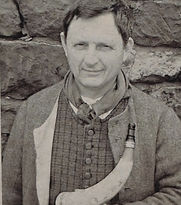
Roland Cadle and Atlee Crouse at the very first Horn Fair, 1996. Photo courtesy Kathy Cadle.
Summary
There is no question as to the success of Reverend Roland Cadle's 'Hornsmithing Seminar.' The impact it had on those in attendance was extraordinary; so much so that officers were elected, a publication decided upon and annual Horn Fairs sanctioned. The coming year would prove challenging for the three officers elected as membership, funding, organizational structure and the location and planning for the next Hom Fair would test the mettle and commitment of this new organization called The Honourable Company of Homers.
~ ~ ~ ~ ~ ~ ~ ~ ~ ~ ~ ~
Please see Historical Documents, Section II. This one sheet contains all the above information that Russ Young later published in the first issue of The Horn Book in March 1996. Russ' note was not discovered until 24 years later.
A huge debt of gratitude is be be given to the Eleven 1996 Charter Members
Roland Cadle
Bob Chattin
Bruce Horne
Jim Leach
Lee Larkin
John Proud
Byron Smith
Clay Smith
George Suiter
Erv Tschanz
Russ Young
On behalf of all Guild members - Past, Present & Future
OUR SINCERE THANKS AND APPRECIATION
~ ~ ~WELL DONE!~ ~ ~
1 Wm. Carter. "Roland Cadle, Master Horner." The Horn Book, May 2009: pg 10.
2 Roland Cadle. "HCH History Project," Email Response, 28 October 2025.
3 Carter, pg 11.
4 Cadle Interview (recorded/transcribed), Krumsville, Pennsylvania, August 22, 2019, pg 3.
5 Cadle Interview, pg 4.
6 Cadle Interview, pg 2.
7 Wm. Carter. "Roland Cadle, Master Homer.' The Horn Book, May 2009: pg 11.
8 Cadle Interview, pg 4.
9 Russ Young, The Horn Book, March 1996: pg I.
10 Cadle Interview, pg 4.
11 Cadle Interview, pg 4.
12 Russ Young, phonecall, Jan 14, 2020.
13 Byron Smith. Response to Questionnaire, Email July 20, 2019: pg 2
14 John Proud, Response to Questionnaire, Email Jan 14, 2020.
15 Lee Larkin, Response to Questionnaire, Email Jan 8, 2020.
16 Smith, Questionnaire, pg 2.
17 Russ Young, phonecon, Jan 14, 2020.
18 Young, The Horn Book, March 1996: pg 2.
19 Appendix XVI, pg 2, Original Notes of Russ Young from the Post-Seminar Meeting: March 2, 1996.
20 Young, The Horn Book, March 1996: pg 2.
21 Young, The Horn Book, March 1996: pg 2.
22 Young, The Horn Book, March 1996: pg 2.
23 Larkin, Response to Questionnaire, Email Jan 8, 2020.
24 Young, The Horn Book, March 1996: pg 2.
25 Cadle Interview, pg 5.